-
Heritage Edition
-
Media
India single malt whisky is a spirit made entirely from malted barley, produced at a single distillery, and aged in oak casks for a minimum of three years. The process mirrors Scotch in its fundamentals — malted barley, copper pot stills, oak maturation — but what happens next is entirely Indian.
India's tropical climate transforms the maturation process. Where Scotland's cool, stable temperatures mean the spirit spends twelve to eighteen years slowly drawing character from the wood, India's heat puts the interaction into overdrive. Temperatures inside Indian warehouses can swing dramatically between seasons, pushing the liquid deep into the cask and pulling it back with each cycle. The result is a whisky that develops rich colour, deep flavour, and genuine complexity in a fraction of the time.
There is also the matter of what is called the angel's share — the portion of spirit lost to evaporation each year. In Scotland, this sits at around 2% annually. In India, the figure climbs to as much as 8–12%. That higher loss is not just a cost; it is a signal of the intense interaction happening inside every cask, contributing to India’s evolving premium single malt category.
The flavour profile of an India single malt tends toward:
This is whisky with a genuine sense of place. You can taste India in every dram.
India’s whisky scene has come a long way. What started as small-scale distilling inspired by colonial influence has evolved into a sophisticated, world-class industry. Indian single malts are now collecting international awards and the respect of serious whisky enthusiasts.
As 2026 unfolds, Indian whisky is not just about local pride anymore; it’s about global recognition. Distillers across the country are refining their craft, blending tradition with innovation, and using India’s unique tropical climate to create whiskies that mature faster, develop deeper flavors, and carry a signature warmth that no other region can replicate.
Here are the Indian single malts you should have on your radar this year. Each bottle tells a story of craftsmanship, culture, and character that reflects the spirit of modern India.
The story of India single malt whisky is surprisingly recent. In the 1980s and 1990s, the Indian market was dominated by blended spirits, and premium whisky largely meant imported Scotch. Single malt as a category barely existed on Indian soil.
That began to change quietly in the late 1990s, when a handful of Indian distillers started experimenting with malted barley and pot still distillation. The real turning point came in 2004, when India's first commercially released single malt launched — not in Mumbai or Delhi, but in Glasgow, Scotland — a statement of intent that Indian whisky could stand alongside the world's best.
Through the 2000s and 2010s, the category grew steadily. Distillers in Goa, Bangalore, the Himalayan foothills of Haryana, and Rajasthan began producing whiskies that were earning gold medals at international competitions, turning heads among serious collectors, and finding shelf space in specialist retailers across Europe and America.
By 2026, India single malt is not a curiosity or a footnote. It is a fully formed, internationally respected category with a growing number of distilleries producing genuinely world-class spirits. India has become the world's largest whisky market by volume, and a growing share of that market is premium, craft, single malt — made with pride and purpose right here at home.
The west coast of India, with its humid coastal air and warm year-round temperatures, has emerged as one of the most exciting new terroirs in this story.
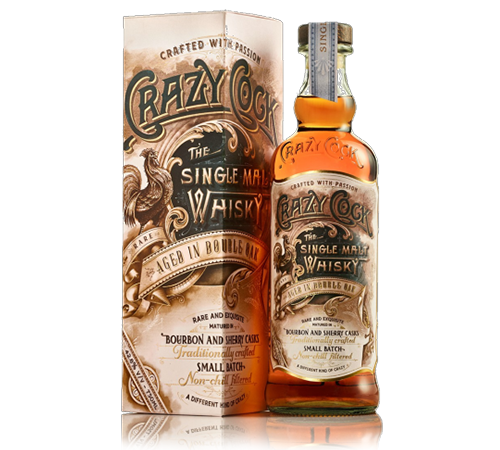
Crazy Cock The Single Malt Whisky — Inaugural Edition: Rare
Matured in a combination of ex-bourbon and sherry casks, Rare offers a beautifully layered drinking experience. On the nose, expect warm caramel, dried apricot, and a gentle wisp of vanilla. The palate opens with honeyed sweetness balanced by dried fruit — dates, raisins, a hint of dark cherry — before spice arrives quietly on the mid-palate. The finish is long, warm, and satisfying, with the sherry influence leaving a trail of rich sweetness that lingers well beyond the last sip. A whisky for those who appreciate depth without aggression.
Crazy Cock The Single Malt Whisky — Inaugural Edition: Dhua
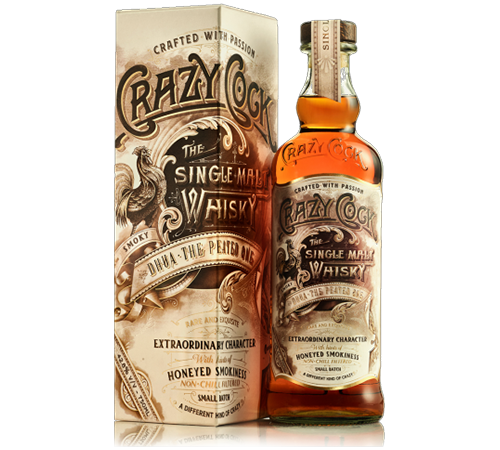
Dhua — meaning "smoke" in Hindi — is Crazy Cock's foray into peated territory. This is a mildly peated, small-batch expression that brings a new dimension to the range. The smoke is present but restrained; it frames rather than dominates. The nose carries soft peat alongside tropical fruit and a light maritime quality. On the palate, smoked barley meets honey and warm spice, creating a balance that is more conversation than confrontation. The finish carries lingering smoke and a gentle sweetness that invites another pour. For those curious about Indian peated whisky, Dhua is a masterclass in subtlety.
Crazy Cock The Single Malt Whisky — Heritage Edition: Madhuca
The Madhuca series is named after the Madhuca tree native to the western coast of India — a nod to the deep local roots of this whisky's character. Expect rich tropical notes shaped by coastal maturation: ripe banana, coconut cream, and dried mango on the nose, with a warming spiced palate of black pepper and ginger. The influence of the Indian ocean air is unmistakable. These are whiskies that carry a genuine sense of the land where they were born.
Understanding how India single malt whisky is made helps explain why it tastes the way it does — and why Indian whisky has earned genuine respect on the world stage.
Malting
It begins with malted barley — grain that has been allowed to germinate briefly and then dried to halt the process. This activates enzymes that will later convert starches into fermentable sugars. Some distilleries use locally grown Indian six-row barley, known for its robust, spicy character.
Mashing
The malted barley is ground into a coarse flour called grist, mixed with hot water, and the resulting sugary liquid — called wort — is extracted.
Fermentation
Yeast is added to the wort. Fermentation typically runs for 48 to 72 hours, during which sugars are converted into alcohol. India's warm climate means fermentation is vigorous and fast, developing the characteristic fruity esters that define Indian single malt.
Distillation
The fermented liquid is distilled twice in traditional copper pot stills. The spirit that emerges — clear and raw — is called new make spirit. The shape and size of the pot still has a direct influence on the final flavour.
Maturation
This is where India's climate works its magic. The new make spirit enters oak casks — often ex-bourbon barrels from the United States, sherry butts from Spain, or specialist casks like Marsala or Port pipes. India's extreme heat drives the spirit deep into the wood on hot days and draws it back out as temperatures cool. What takes a decade in Scotland can develop in just a few years in India.
Bottling
When the master distiller judges the whisky ready, it is drawn from cask, sometimes married with spirit from other barrels to build complexity, and bottled. Many premium Indian single malts are bottled without chill filtration to preserve the natural oils that carry flavour.
Not all Indian single malts are the same, and geography plays a central role in why. India is a vast country with dramatically different climates — the high, cool altitudes of the Himalayan foothills produce different maturation conditions to the humid, tropical air of the western coast.
Crazy Cock is distilled and matured on the west coast of India, where the climate is defined by warmth, humidity, and the influence of the Arabian Sea. This coastal environment creates specific conditions for maturation: consistent warmth drives steady cask interaction, while the oceanic air adds a subtle mineral quality that you simply cannot replicate inland.
This terroir — a term borrowed from wine, but equally applicable here — shapes the final character of the spirit. The tropical fruit notes, the warmth on the palate, the particular way the sweetness of the cask mingles with the spice of the barley — all of this is influenced by the specific place where Crazy Cock is made.
In a world of single malts, provenance matters. Crazy Cock is not trying to imitate any other region or tradition. It is making whisky that could only come from this specific stretch of Indian coastline.
If one name has quietly but confidently reshaped India’s whisky landscape, it’s Crazy Cock Indian Single Malt Whisky. Crafted on the west coast of India, this whisky represents a new generation of Indian distilling — artisanal, ambitious, and unapologetically character-driven.
Crazy Cock is distilled in traditional copper pot stills using select Indian barley and aged in carefully selected oak casks. The result is a whisky layered with notes of spice, honeyed sweetness, and dried fruit, balanced by hints of vanilla and oak. Every sip reflects patience and precision.
Drinking single malt whisky well is not complicated — but a few simple choices make a real difference to the experience.
Neat, in a tulip-shaped glass. This is the purest way to experience the spirit. A tulip or Glencairn glass concentrates the aromas toward the nose. Pour a measure, let it rest for one to two minutes, and smell before you sip. You will catch layers you might otherwise miss.
The brand’s portfolio goes even further with limited releases such as Crazy Cock The Single Malt Whisky Dhua, a mildly peated small-batch single malt, and Crazy Cock The Single Malt Whisky Rare, matured in both bourbon and sherry casks for extra depth. These expressions redefine what luxury means in Indian whisky by combining heritage, terroir, and innovation.
Crazy Cock is India’s quiet revolution in a bottle. It combines old-world craftsmanship with tropical maturation to deliver a bold, refined spirit that’s earning attention not just in India but also in international whisky circles. It’s one of those rare whiskies that feel handcrafted yet polished — proof that India can play at the highest level of whisky artistry.
The rise of Indian single malts isn’t a passing trend. It’s the result of decades of learning, experimentation, and ambition. What makes India unique in the whisky world is its tropical climate, which accelerates the interaction between spirit and wood. In Scotland, maturation can take twelve to eighteen years. In India, similar depth and colour can develop in just six to eight years. This creates whiskies that are naturally rich, flavourful, and full of life.
Whether it’s the small-batch precision of Crazy Cock The Single Malt Whisky, Indian whisky is now an ecosystem of creativity and confidence.
So as 2026 unfolds, pour yourself a dram that tells a story of progress and pride. The golden age of Indian single malts isn’t coming — it’s already here.