Home /
Blog /
The Role of Time Between Distillation and Bottling in Indian Single Malt Whisky
Posted on 11 June 2026
The Role of Time Between Distillation and Bottling in Indian Single Malt Whisky
Introduction: Beyond Aging—The Importance of Resting
When discussing Indian Single Malt, most attention is given to aging—the time spent in casks. However, an
equally important but often overlooked phase lies between distillation and bottling.
This period, which includes resting and marrying, plays a critical role in shaping the final character of
single malt whisky. It is during this time that the spirit stabilizes, integrates, and develops cohesion.
For single malt whiskey, this stage is not about introducing new flavours, but about refining and
aligning what already exists. In premium single malt, this quiet phase ensures that the final product
feels complete rather than fragmented.
What Happens After Distillation
A Transitional Phase
After distillation, Indian single malt whisky:
- Is separated from its raw form
- Contains multiple volatile compounds
- Requires stabilization
Not Yet Ready for Bottling
Freshly distilled single malt whiskey:
- Can feel sharp
- Lacks integration
- Needs time to settle
The Concept of Resting
Allowing the Spirit to Settle
Resting allows single malt whisky to:
- Stabilize after distillation
- Reduce volatility
- Achieve internal balance
Impact on Texture
For Indian Single Malt, resting helps:
- Smoothen mouthfeel
- Soften edges
- Improve overall cohesion
The Process of Marrying
Combining Different Casks
Even within single malt, distillers may combine:
- Different cask batches
- Slightly varied profiles
- Complementary characteristics
Integration Over Time
Marrying allows single malt whiskey to:
- Blend seamlessly
- Balance flavours
- Achieve consistency
Why Time Matters in This Stage
Chemical Integration
During resting and marrying, single malt whisky undergoes:
- Molecular interaction
- Flavour integration
- Stabilization
Avoiding Imbalance
Without this stage, Indian Single Malt may:
- Feel disjointed
- Show uneven flavour
- Lack refinement
Influence on Flavor Profile
Harmonizing Notes
Time between distillation and bottling helps single malt:
- Align sweetness, wood, and spirit
- Reduce sharp contrasts
- Create a unified profile
Enhancing Complexity
For single malt whisky, this stage:
- Does not add new flavours
- Refines existing ones
- Improves perception
Impact on Aroma and Finish
Aroma Stability
Rested single malt whiskey:
- Releases aroma more evenly
- Feels more controlled
- Maintains clarity
Cleaner Finish
Properly rested Indian Single Malt:
- Delivers smoother finishes
- Avoids abrupt endings
- Feels more complete
The Role of Controlled Conditions
Storage Environment
During resting, single malt whisky must be:
- Stored in stable conditions
- Protected from fluctuations
- Monitored carefully
Process Discipline
For Indian Single Malt, this ensures:
- Consistency
- Predictability
- Quality control
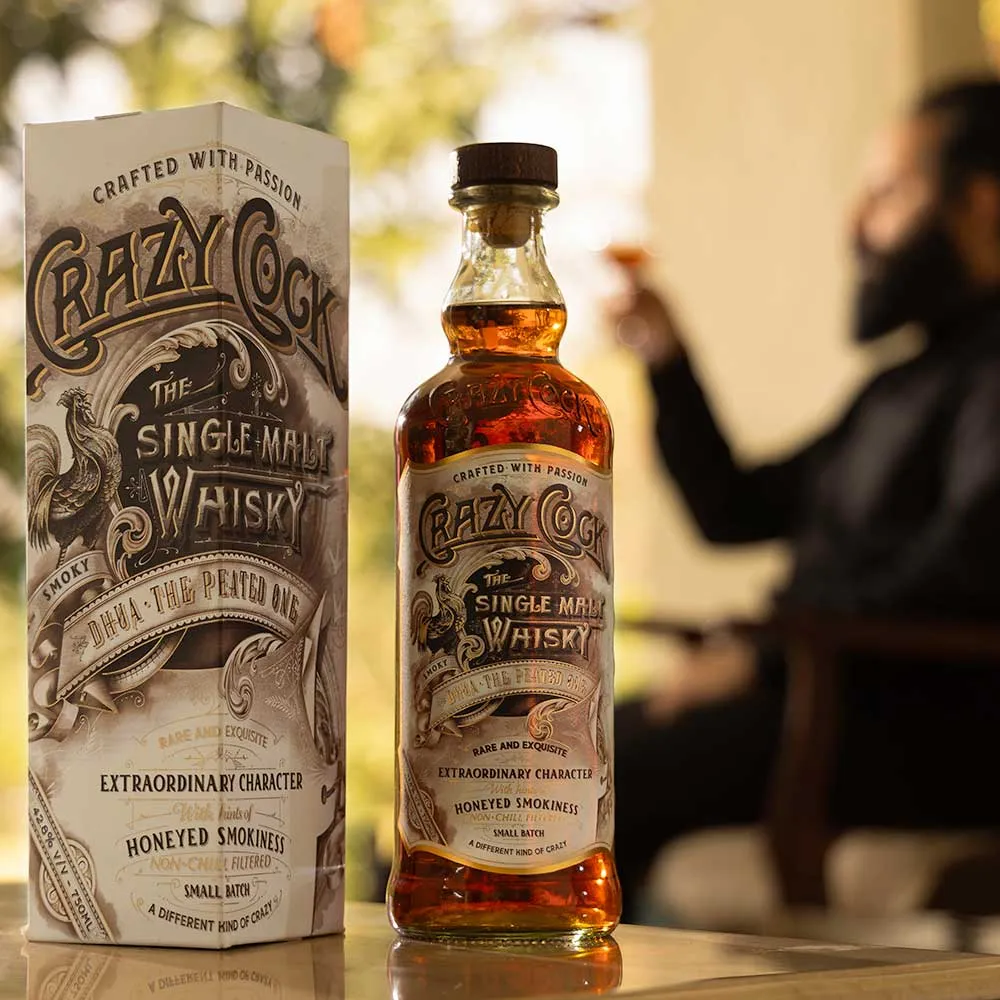
Crazy Cock Single Malt Whisky
Crazy Cock and Structured Resting
Precision in Process
Crazy Cock ensures its Indian single malt whisky:
- Undergoes controlled resting
- Is carefully monitored
- Maintains consistency
Portfolio Consistency
Expressions such as Madhuca I, Madhuca II, Madhuca III, Dhua, and Rare reflect how single malt benefits
from structured time between distillation and bottling.
Why This Stage Is Often Overlooked
Focus on Aging
Most discussions around single malt whisky emphasize:
- Cask aging
- Years in barrel
- Maturation
Hidden but Critical
However, the resting phase in Indian Single Malt:
- Directly affects quality
- Enhances balance
- Improves final experience
The Future of Process Awareness
Educated Consumers
As awareness grows, drinkers of single malt whiskey are:
- Paying attention to process
- Understanding production stages
- Valuing craftsmanship
Greater Transparency
Brands of Indian single malt whisky may increasingly:
- Highlight resting periods
- Explain marrying processes
- Emphasize refinement
Conclusion: Time as a Finishing Tool
The journey of Indian Single Malt does not end with distillation or even aging. The time between
distillation and bottling plays a critical role in shaping the final spirit.
Through resting and marrying, single malt whisky becomes more cohesive, balanced, and refined. It is
during this phase that the spirit transitions from raw output to finished product.
Because in crafting great single malt whiskey, time is not just about aging—it is about finishing with
precision.