-
Heritage Edition
-
Media
India's whisky story has changed. For decades, the conversation around single malt revolved around imported Scotch. Today, Indian single malt whisky has carved out a distinct identity — shaped by tropical climate, indigenous ingredients, and a new generation of distillers who refuse to simply imitate the West. contributing to India’s evolving premium single malt category.

This guide covers everything you need to know before choosing an Indian single malt whisky in 2026 — what to look for, what to avoid, and why Crazy Cock's range stands out in a crowded market.
Like its Scottish counterpart, Indian single malt whisky is made from 100% malted barley and distilled at a single distillery. What makes it distinctly Indian is everything that follows: the climate, the cask selection, and increasingly, the use of native botanicals that have no parallel anywhere else in the world.
India's tropical heat accelerates the maturation process dramatically. A whisky that would take 10–12 years to develop character in Scotland can achieve comparable depth in significantly less time in a place like Dahanu, Maharashtra — where the Arabian Sea and the Sahyadri mountains create a microclimate unlike anything in the traditional whisky world.
Single malt must come from one distillery. In India, who the distiller is matters — legacy, equipment (copper pot stills make a difference), and maturation warehouse conditions all shape the final spirit.
This is where Indian producers are genuinely innovating. Beyond the standard Bourbon and Sherry casks, some distillers are now experimenting with woods native to the subcontinent — most notably mahua (Madhuca longifolia), a flowering tree sacred to the forests of central India. The result is flavour that is completely uncharted in global whisky.
India's heat means faster angel's share (the portion lost to evaporation) and more intense wood interaction. This is a strength, not a shortcut — when managed well, it produces whiskies with remarkable depth for their age.
A well-made Indian single malt whisky delivers multiple layers on the nose, palate, and finish. Watch out for one-note whiskies that lead with heat and little else.
A long, evolving finish is a hallmark of quality. Short or harsh finishes usually signal underdeveloped maturation or poor cask selection.
Crazy Cock is produced by South Seas, one of India's oldest malt distilleries with over a century of distilling history, located in Dahanu, Maharashtra. The brand is now in its fourth generation, and its approach is the opposite of safe: it uses India's largest copper pot stills, sources rare private casks from around the world, and has pioneered what may be the most genuinely original innovation in Indian single malt whisky — finishing in ex-Mahua casks.
In 2025, Crazy Cock won Best in Show in the Indian Single Malt category at the IWS Awards (Vinexposium) — one of the most credible international spirits competitions. That's not marketing. That's validation.
Here's a breakdown of each expression:
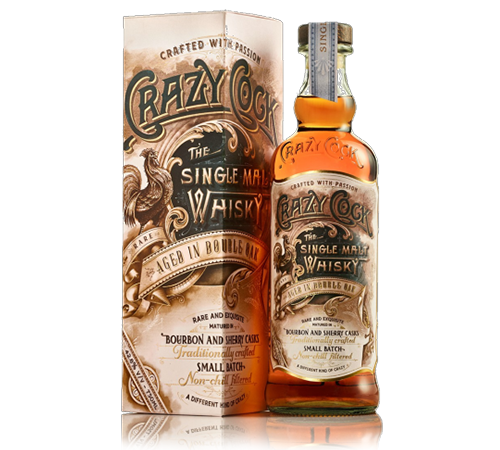
Matured in a combination of Bourbon and Sherry casks, Rare is the most accessible entry point in the range. It delivers warmth, vanilla, dried fruit, and a refined finish — full-bodied and consistent. Best for: First-time Indian single malt drinkers, everyday sipping
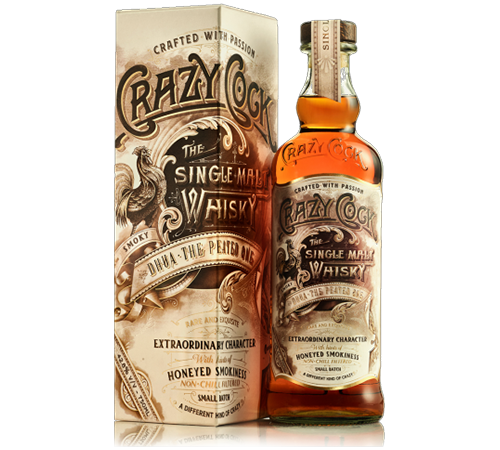
Dhua (Hindi for "smoke") is a mildly peated expression aged in Bourbon and Sherry casks. The peated malts used are notably old, giving Dhua a mellowness that many peated whiskies lack. Smoky without being aggressive. Best for: Fans of peated Scotch looking for an Indian alternative
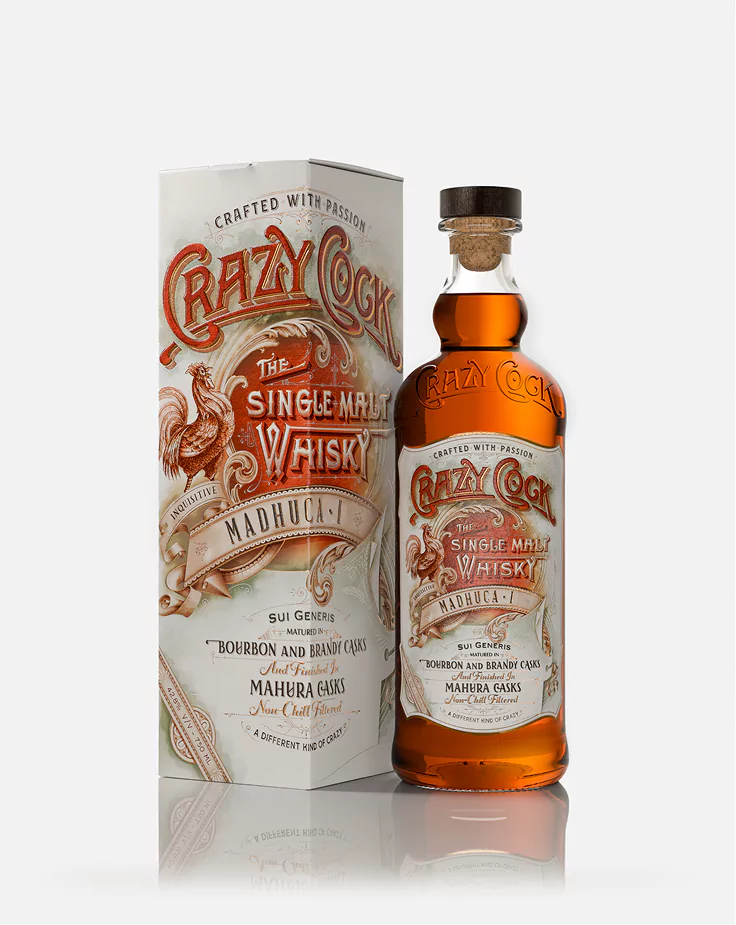
This is where Indian single malt whisky enters territory no one else has explored. Madhuca I begins in ex-Brandy and ex-Bourbon casks, building warmth and fruit character — then finishes in ex-Mahua casks. The result is floral, earthy, and subtly sweet in a way that's completely native to India. Best for: Curious drinkers who want something genuinely new
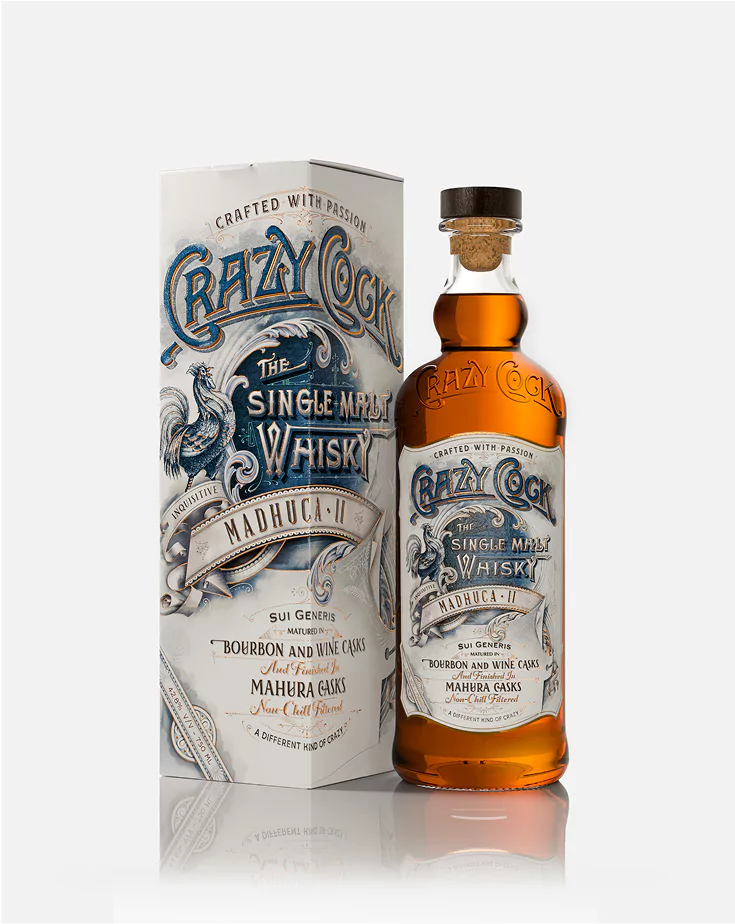
Matured in ex-Bourbon and ex-Wine casks before its Mahua finish, Madhuca II develops layers of apricot, vanilla, zesty citrus, and marzipan. The Mahua influence integrates more deeply here, adding structure and a longer finish. Best for: Those who want complexity with elegant balance
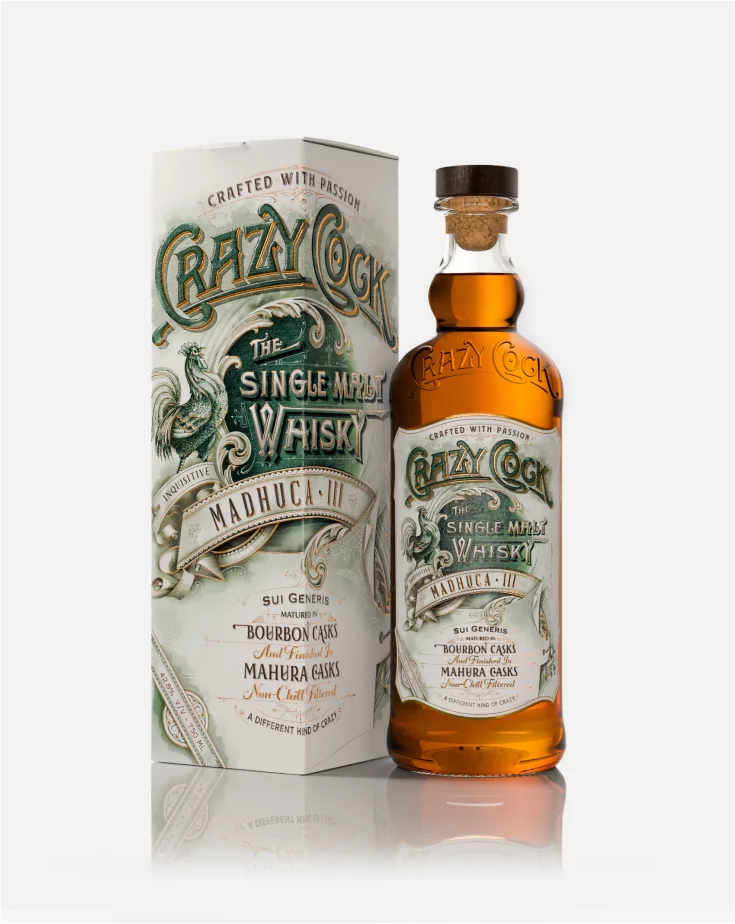
The most evolved expression in the lineup. Distilled using copper pot still techniques and finished in ex-Mahua casks at South Seas — the only distillery in the world to have also matured Mahua spirits in oak. The result is a whisky with extraordinary depth, pronounced cask character, and a finish that lingers long after the glass is empty. Best for: Serious whisky enthusiasts, collectors, special occasions
Mahua is not a gimmick. It is one of India's most historically significant trees — used for centuries in tribal communities across central India for food, medicine, and spirit-making. South Seas is the first distillery to have matured Mahua spirits in oak casks, and the Crazy Cock Madhuca series takes this a step further by finishing single malt whisky in those very casks.
No other Indian single malt whisky — or any whisky globally — does this. That's not a small thing.
| Drinker Profile | Recommended Expression |
|---|---|
| New to Indian single malt | Crazy Cock Rare |
| Loves peated/smoky whiskies | Crazy Cock Dhua |
| Wants something truly original | Madhuca I |
| Seeks balance and complexity | Madhuca II |
| Serious enthusiast / collector | Madhuca III |
It's a whisky made from 100% malted barley, distilled at a single distillery in India, and matured in oak casks. India's tropical climate accelerates ageing and creates flavour profiles distinct from Scotch or Irish whisky.
Indian single malts are increasingly winning at international competitions. Crazy Cock won Best in Show at the IWS Awards 2025 — competing against global entrants. The question isn't whether Indian single malt is "as good." It's whether you've tried the best of it.
Its use of ex-Mahua casks is genuinely unprecedented globally. Combined with a fourth-generation distilling legacy, copper pot still production, and a portfolio spanning five distinct expressions, it's one of the most complete ranges in Indian single malt whisky.
At South Seas distillery in Dahanu, Maharashtra — a coastal town between the Arabian Sea and the Sahyadri mountains, known for its tropical microclimate.
42.8% for the domestic Indian market, and 46% for select duty-free outlets.
Crazy Cock Rare — it's the most approachable, with a warm, balanced profile from double oak maturation.
Indian single malt whisky in 2026 is not a curiosity. It is a category. And within that category, Crazy Cock stands apart — not because it chases trends, but because it is building something entirely its own: a range of Indian single malts that are rooted in this country's landscape, history, and botanical heritage.
If you haven't tried it yet, Madhuca I is where to start. By the time you reach Madhuca III, you'll understand why.