Home /
Blog /
Can Indian Single Malt Whisky Replace Scotch in Global Bars? A Shift in Preference
Posted on 11 June 2026
Can Indian Single Malt Whisky Replace Scotch in Global Bars? A Shift in Preference
Introduction: A Changing Global Landscape
For decades, Scotch has defined the global perception of single malt whisky. It has dominated bar menus,
shaped consumer expectations, and set the benchmark for quality. However, in recent years, a shift has
begun to take place.
Indian single malt is emerging as a serious contender in global bars, challenging long-held preferences.
What was once seen as a regional category is now gaining international attention for its distinct
identity, bold flavour profiles, and evolving craftsmanship.
The question is no longer whether single malt whiskey from India can compete—it is whether it can replace
Scotch in certain contexts.
The Legacy of Scotch in Global Bars
A Long-Standing Benchmark
Scotch has historically represented:
- Tradition and heritage
- Consistency and recognition
- A global standard for single malt
Consumer Familiarity
For many drinkers, Scotch remains:
- The default choice
- A symbol of quality
- A trusted category
This deep-rooted familiarity is one of its strongest advantages.
The Rise of Indian Single Malt
Rapid Category Growth
Over the past decade, Indian single malt whisky has:
- Expanded its presence internationally
- Built credibility among enthusiasts
- Gained recognition in premium segments
A Distinct Identity
Unlike Scotch, single malt whiskey from India offers:
- Faster maturation due to climate
- Bolder flavour profiles
- A unique production environment
Flavor as a Differentiator
Bold and Expressive Profiles
Indian single malt is known for:
- Intense flavour development
- Strong cask interaction
- Distinct character
A New Experience for Global Consumers
This allows single malt whisky from India to:
- Offer something different from Scotch
- Appeal to adventurous drinkers
- Stand out on bar menus
Changing Consumer Preferences
Curiosity and Exploration
Modern consumers are:
- Open to new categories
- Interested in diverse origins
- Driven by experience
Moving Beyond Tradition
As a result, single malt whiskey drinkers are:
- Exploring non-traditional regions
- Trying new flavour profiles
- Expanding their preferences
The Role of Bars and Mixologists
Curating Unique Experiences
Global bars are increasingly:
- Introducing lesser-known categories
- Highlighting craft spirits
- Offering curated selections
Indian Single Malt on Menus
This creates space for Indian single malt whisky to:
- Gain visibility
- Build awareness
- Compete with established categories
Price and Value Perception
Competitive Positioning
In many cases, single malt whisky from India:
- Offers strong value
- Competes within premium ranges
- Provides differentiation without excess pricing
Value Beyond Cost
Consumers evaluate single malt based on:
- Experience
- Uniqueness
- Overall quality
Can Indian Single Malt Replace Scotch?
Replacement vs Expansion
Rather than complete replacement, Indian single malt is:
- Expanding the category
- Offering alternatives
- Creating new preferences
Context Matters
In certain settings, single malt whiskey from India can:
- Replace Scotch on menus
- Appeal to specific audiences
- Define new drinking experiences
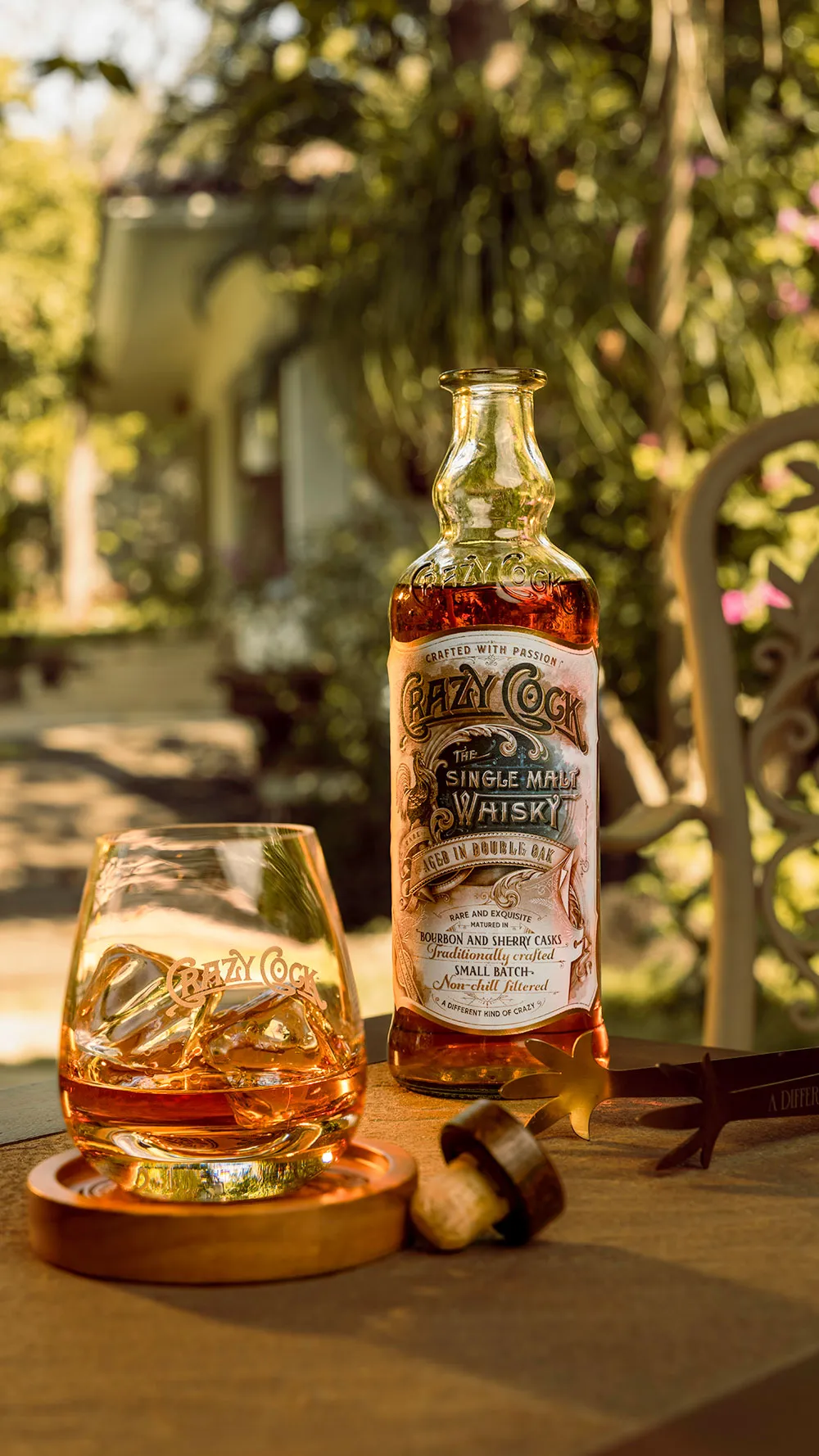
Crazy Cock Single Malt Whisky
Crazy Cock and the Global Conversation
Representing Indian Craft
Crazy Cock’s Indian single malt whisky reflects:
- Structured production
- Defined flavour profiles
- Consistent quality
Building Recognition
With expressions like Madhuca I, Madhuca II, Madhuca III, Dhua, and Rare, the brand demonstrates how
single malt from India can stand confidently alongside global offerings.
Challenges to Overcome
Awareness and Education
For wider acceptance, Indian single malt must:
- Build global awareness
- Educate consumers
- Strengthen positioning
Breaking Perception Barriers
Some consumers still associate single malt whisky primarily with Scotland, making perception a key
challenge.
The Future of Global Bars
More Diverse Selections
As bars evolve, menus will likely include:
- Multiple origins
- Diverse flavour profiles
- Emerging categories
Indian Single Malt’s Role
Indian single malt whisky is positioned to:
- Gain more shelf space
- Build global demand
- Influence future trends
Conclusion: A Shift, Not a Replacement
The rise of Indian single malt does not signal the end of Scotch—it signals a shift in preference.
As global consumers become more open and exploratory, single malt whisky from India is carving out its
own space. In some cases, it may replace Scotch. In others, it will exist alongside it, offering a
different experience.
Because the future of single malt whiskey is not about one region dominating—it is about multiple
identities coexisting.